
Museum Encounter: Van Dycks
Winter 2025. A quiet morning at the museum. Two very well-dressed men come in. Let’s call them Lucas and Nathan. Late forties, early fifties? I greet them. Is that an American accent… or Canadian? I need to get that right!
About 5 minutes later, I notice that they are still looking at our ‘Heritage Highlights’ display case, and the adjacent exhibits showcasing the 2005 events – the wedding of Prince Charles and Camilla Parker Bowles, and the civil partnership of Elton John and David Furnish. I’m inquisitive, maybe too much so!
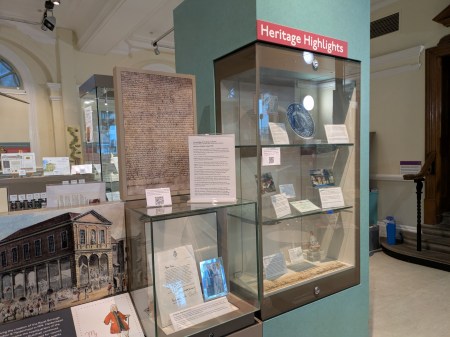
My mother often told me that I’d talk the hind legs off a donkey! I ask them if they need any help? Lucas tells me that they are from Canada and very keen to learn more about the ‘Royals’. Danger alert! Something else to get right. Our King and Queen are their King and Queen too! I ask where they are visiting from? Have they been before? It turns out that they are from Vancouver. They travel frequently to the UK and to France where they have a home.
Ten minutes later, the three of us are upstairs in the Vestibule. They’ve asked for a tour. I show them the huge display board listing the names of our Bailiffs and Mayors since 1321 (described as ‘Bailiffs’ in the early years). I mention that it’s not as old as it looks, having been compiled and painted when the Guildhall was refurbished in 1951 – with significant support from the good folk of Windsor, Ontario! We look briefly at the Civic Collection, then at the Hurricane commemorative plate. Over 1400 Hurricanes were built in Canada; engines were usually fitted in Britain. I point out the 1977 Silver Jubilee commemorative vase. Lucas and Nathan try to identify the silhouettes of the Queen and Prince Philip.
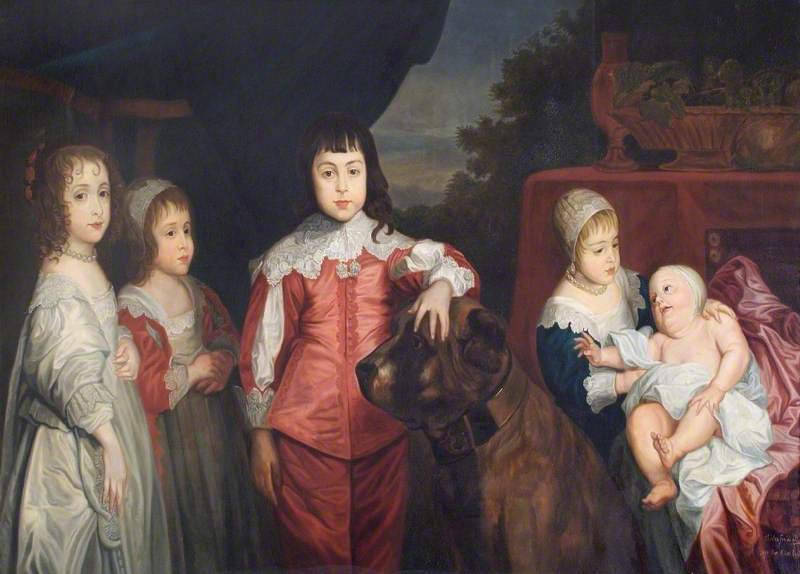
Finally, we look at the painting of ‘The Five Eldest Children of Charles I’ by Charles Fullwood. I point out that it’s a copy of the magnificent work by Antony van Dyck that hangs (with 9 other van Dycks) in the Queen’s Gallery at Windsor Castle. The original is stunning, with the future Charles II resting his hand on the head of an enormous mastiff, which looks as if it’s about to jump off the canvas!
Have they been to the castle? ‘Yes, many times!’
Have they seen the Van Dycks? There’s a pause, and Lucas and Nathan exchange glances. After a few seconds, Nathan responds….’We don’t normally mention this to people. We’ve actually got a Van Dyck in our apartment in Vancouver’. I intended to reply professionally but I think my response was simply ‘Wow!’ Nathan continues, ‘Not as big as the one in the Castle, but a fair size. We love it! We’ve had it authenticated by Sotheby’s, and at a second specialists’.
I’ll never know how much it was worth! I was itching to ask, but managed to contain my curiosity. For anybody interested, Christie’s has 9 for sale (Sotheby’s don’t show sold prices). They start at around £150k, most are £2m – £3m. The world record for a Van Dyck at auction is £8.3m (his Self Portrait, sold in 2009). It was later put on sale for £12.5m but subsequently offered to the National Portrait Gallery for £10m. The target was reached in 2014 with the help of a public appeal and significant grants from charities and trusts, including £6m from the Heritage Lottery Fund.
by Gerald Hyder
The Holocaust Connection
Spring 2018. I picked up the museum phone. The caller was doing some research about ‘Woodcote House’ – a large house that had been located near Ascot Racecourse, and demolished in the 1990s. Apparently, it had been used from the Autumn of 1945 until 1947 to house refugees from Europe. Were we aware of it?

I’d never heard about it – and I live a little more than a mile from Ascot. I took details and promised to pass them on to the museum team and to the local studies officer. I told her that I lived nearby and would contact Facebook groups and elsewhere to see if any locals had any memories they could share. A few weeks later, I forwarded her some memories from 3 or 4 people, and some suggestions as to who else might help.
I thought no more of it until a few months later when I was browsing online and found the story quite prominently on the BBC website – ‘The ‘Belsen Boys’ Who Moved To Ascot’ (the title was not strictly correct – the boys came from camps across Europe).
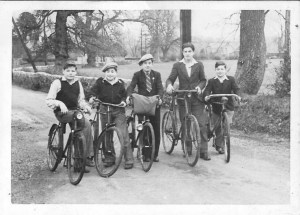
The caller – Rosie Whitehouse – was a freelancer, prepping something for the BBC. I kept in touch with her for a year or so, in particular the possibility of some information being displayed in the Ascot Library. I met her again when the Parish Council invited my wife and I to a commemoration event on Holocaust Memorial Day 2019. It was very moving, with Yiddish prayers and rituals. We held candles.
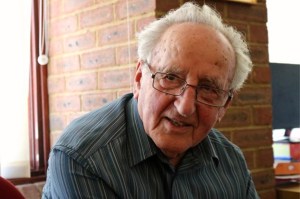
Two elderly men – Ivor Perl and Sam Freiman – were guests of honour. Both had been liberated and had lived in Woodcote House. Sadly, Sam Freiman is no longer with us, but Ivor Perl – now 92 years old – still dedicates his time to sharing his story. A remarkable man.
In 2020, I put together a PowerPoint presentation about Woodcote House. It’s loaded onto the audiovisual display in the Museum (the one with the virtual tour of the Guildhall on it). We have also reproduced it here:
by Gerald Hyder
Museum Encounter: German Nobility
Probably the most distinguished member of any group that I have guided round the Guildhall turned up just before the pandemic. He was a well-dressed gentleman in his fifties and asked me several questions in a distinctive accent……
As we were going downstairs at the end I asked him where he was from. “I am from Germany,” he said. “I am Prince Donatus, Landgrave of Hesse.” Germany’s nobility, of course, lost all power at the end of the First World War with the setting up of the Weimar Republic, but many of its members, like those of other former noble families in Europe, hold on to their honorific titles to this day. Prince Donatus is a descendant of Queen Victoria and a relative of Prince Philip, whose funeral he attended. He was also present at the funeral of Queen Elizabeth and the coronation of King Charles.
As he left the Guildhall, I said I hoped he would enjoy the rest of his visit to Britain. “No,” he said, “I live in Uxbridge.”
by Richard Snailham
Visitors
Although I haven’t met anyone that you could call famous at the Museum, and I certainly can’t beat Richard’s story, I have met some really interesting visitors.
Just before lockdown, I did a tour with an elderly Australian couple. When we reached the council chamber, the gentleman said, “Oh yes, I recognise some of these portraits. We have that one and those two over there and this one.” By now, I was rather bemused! His wife smiled and said,”He’s the Governor of Queensland and we’re dining at the Castle tonight with the Queen.” We had a very pleasant tour and, shaking my hand as they left, he said that they had enjoyed it immensely. About two weeks late,r a parcel arrived at the Museum addressed to me. Inside was a beautiful book about Government House, Queensland, showing photos of all the portraits and a very nice ‘thank you’ note.
Amongst others that I’ve met unexpectedly was the grandson of one of the crew of the Dornier from which we have a piece of wreckage on display within the Museum. He didn’t expect to see or hear anything about the incident and was overjoyed when we gave him a copy of our research, none of which he knew about, and I gave him directions to the crash site.
A retired American lawyer was amazed to see our exhibit concerning Roderick Maclean and his attempted assassination of Queen Victoria. He had studied the case in detail at law school many years ago!
by Len Nash
Museum Encounter: Battle of the Bulge
About a year ago, I spotted a couple – probably in their mid-50s – looking at the military history display. I engaged with them and pointed out that the case included a ‘Dead Man’s Penny’, which was in my view, probably the saddest item on display in the Museum. He introduced his wife and himself as being from ‘New York State, USA’. I wasn’t aware that there might be more than one but kept that to myself! His wife hardly spoke at all.
‘We’ve just been to the D-Day beaches. Very moving’ says he. I reply ‘Funny enough, so have I. My wife and I were there a fortnight ago……’
‘My uncle landed on Omaha’, he continued, ‘Thankfully not in the first wave’.
‘How weird’, says I, ‘My uncle landed on one of the British beaches. D-Day+2. He was with a tank unit, and survived Normandy, had a tough time through to Germany’.
‘My uncle made it too’, says the American, ‘but had an awful time at the Battle of the Bulge’. ‘Yes, I’ve read how bad that was’, I reply, ‘Crack Panzer Divisions and 16-year-old kids’.
‘My uncle was there’, says the American, ‘and so was my wife’s uncle’. His wife adds in a drawl ‘Yeah, he was there……’.
‘Wow’, I respond, ‘What an amazing coincidence!’
‘More than a coincidence’, says the American, ‘My uncle was fighting for the US Army; my wife’s uncle was fighting for the Germans!’
What a strange world we live in!
by Gerald Hyder
An Old Codger’s Treasured Memory
It was on the occasion of one of Her Majesty’s ‘walkabouts‘ in Windsor that I escorted my dear friend Doris Mellor down to the barricade at the end of Park Street, opposite the Post Office as was. It was a cold, chilling day, but Doris was determined to see Her Majesty pass by, and so was I.
The moment arrived when our Queen, with her companions, began to pass by towards the High Street, when suddenly she was distracted and walked directly towards us. Her Majesty came straight to our barricade and said, “Doris, what on earth are you doing here? You will catch your death of cold!.” Doris answered, “I just want to see you again Ma’am”.
The Queen then chatted briefly with Doris and then ordered her to go home to get warm. Doris replied, “Don’t be concerned Ma’am, Ian will drive me home very shortly”. Her Majesty then addressed me and said, ”Thank you Ian. Please take Doris home now before she catches her death of cold.” I said, “I will Ma’am”.
So that is my cherished memory. The Queen spoke to me, addressing me by my first name! I have to admit that I feel kind of ennobled by it. Some of my chums who were nearby on that day ‘put it about a bit‘ that I actually curtsied to Her Majesty. It was a very long time ago and so now I cannot confirm or deny it.
Last September (2021), my wife and I received a greetings card of congratulations from Her Majesty on the occasion of our diamond wedding anniversary and which we display proudly in our home.
My wife and I wish Her Majesty good health and very warm wishes at this time.
by Ian J. Burley
Memories of the Archive Store
Before we had a museum, volunteers used to meet at the Museum’s Archive Store on a Wednesday morning to help the curator look after the Royal Borough Museum Collection. The usual suspects were Leslie Grout, Hester Davenport, Pamela Marson, Brigitte Mitchell, Beryl Hedges and Malcolm & Gloria Lock, but each week there would be just four of us as space did not allow for more. There was always a lot of chatting and banter around the table, but mostly we talked about the museum we were all hoping for.
On one Wednesday morning in May 2003 in an idle moment, Hester, Pamela, Leslie and Brigitte decided to write a poem about our plight.
We are the volunteers, the volunteers are we,
A-working down in Tinkers Lane, we do it all for free.
We are the knights of Tinkers Lane, but tinkers we are not,
Tho’ when you come to see the store, you’ll think that’s what you’ve got!
The town has no museum, so everything’s in store,
But packing things and stacking things, is a tremendous chore.
A place is in the pipeline, they say, but we ourselves,
Just hear the gurgling in the pipes, around the storeroom shelves.
Once a year, we organised an open day at the Archive Store and everyone was invited. There was a hustle and bustle to get the place tidied up, artefacts were liberated from their boxes and off shelves and laid out on tables for visitors to inspect. We were allowed extra space in the Canteen, and short talks were given during the day on different displays. There was always a steady stream of visitors throughout the day, and one could often hear the words “This should really be displayed in a proper museum.”
 Friends of Windsor Museum