
We asked the Friends to tell us their favourite object within The Collection. Not surprisingly, they all have something different and all for personal reasons. We will be showcasing their selections here and in their own words. Do you want to add to it?
The Pedlar Dolls
Hello Everyone,
Well, it looks like I am the first of the volunteers to do a write up on my favourite museum object, on our new website, so here goes!
I have been a Volunteer in the museum for 12 years, originally organising the children’s activities during the school holidays, Christmas and event days. For the past 8 years, I have been working in the museum store as a curatorial Volunteer, Friends treasurer and committee member.
My absolute favourite objects in the store are the Pedlar Dolls. These dolls were created in 1820 and stand about 9” high, dressed in Regency dress and holding trays displaying their wares.
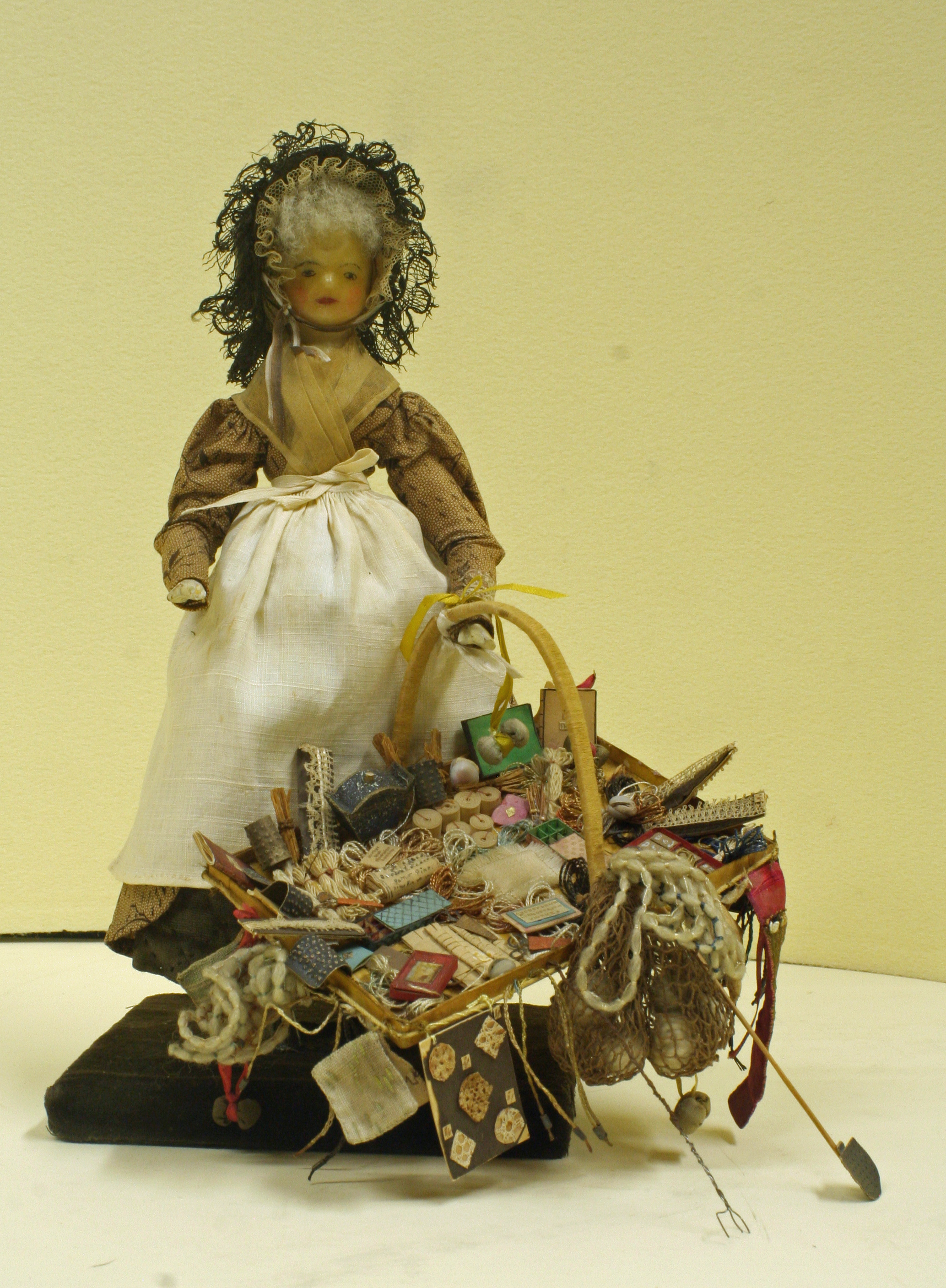

The dolls are carrying the most amazing miniature items in their baskets: ranging from books to beads to strings to pegs, to a toasting fork. All kinds of useful goods of the time that everyone needed to buy for day-to-day chores. Every time you look, you will see another item you missed before. If you use a magnifying glass, you are even able to read the labels!
Their costumes are so beautifully sewn. Take special note of the male’s brocade waistcoat and cravat, and the female’s lace bonnet and shawl. The detail is incredible!
You may also remember, some years ago, during one of the children’s activities, along with Sue Richardson, we recreated a life-size female Pedlar Doll. We used one of the antique mannequins from the Archive Store for the form. We named her Ida. She even wore a silver brooch with her name on it.
Ida stood for a couple of years in the museum, guarding the stairs to the Chambers while the children made their own miniature Pedlar trays to take home. She caused a lot of interest, even more so when we could show her miniature self on display. When asked who Ida was, I would say she was a local, well-known trader who used to sell her goods every day on the Corn Market and kept a watchful eye over the Guildhall at night. Not causing too many nightmares, I hope!!!!!
You can also view these beautiful dolls on the Museum’s Website in the home life & leisure category. I hope you will enjoy and admire the craftsmanship and skill as much as I do.
by Chrissie Regale-Day
The Festival of Britain 1951 Stained Glass Window, Ascot Room
My favourite object? My initial choice certainly had a dark and uncertain past. My second choice was something that I often described to visitors as ‘perhaps the saddest item in the Museum’. Best to write about these another time!
I settled on something truly glorious! It’s the stained glass window in the Ascot Room. It was installed to celebrate the renovation of the Guildhall in 1951 – the year of the Festival of Britain. It also recognised the strong bond of friendship between Windsor in Ontario, Canada, and our own Windsor. The window dominates the room and is a riot of colour! It sits between the two formal portraits of Queen Victoria’s youngest son and daughter – Prince Leopold and Princess Beatrice. The window represents generosity, friendship, imagination and craftsmanship. Even on a dull day, it brings a smile to my face, and when the sun streams into the room, it is magnificent!

The Festival logo appears in the top corners, the Mayor’s seal fills the central medallion; above and below are the Borough Arms and the Arms of the City of Windsor, Ontario. British and Canadian national emblems appear at the side.
I’ve been unable to establish where the window was made. The ‘Stained Glass Works’ at Old Windsor is long gone (they closed in 1890). ‘Artemis Glass’ in Staines (who created the two stained glass windows on the east wall marking the diamond anniversary of the accession of Queen Elizabeth II) were not established until 1999. If anybody can help solve this mystery, please contact us!
The Festival took place six years after the end of World War 2 and was initially intended to celebrate the 100th anniversary of the Great Exhibition of 1851. It rapidly became a celebration of Britain and its achievements, and highlighted the best of British manufacturing, technology, design, and culture. The country was still recovering from the war, the economy was struggling, and some foods were still rationed. Large areas of London and other cities were still scarred with bomb sites.
The Festival centred on what is now the South Bank; the Royal Festival Hall is the only significant remnant. The need for fun was not forgotten! The main site had numerous attractions, and a few miles away in Battersea Park the ‘Festival Flower Gardens’ and an amusement park (which remained until the mid-1970s) were created. 8 million people visited the South Bank site over the 5 months of the exhibition; 8 million more visited Battersea Park, and millions more visited the regional events. This was from a population of 49 million – astonishing!
Councils were encouraged to arrange initiatives. The Guildhall had become dilapidated. In 1938 it had been identified as the command centre for the civil authorities should it be needed. It was also a food store where residents got their ration books. The cost of renovation was estimated as over £7000. This included removing the windows enclosing the Corn Market, installing electricity (yes!), and a general refurbishment. An appeal was launched. The Mayor and citizens of Windsor, Ontario offered to help and made a significant contribution. The then Princess Elizabeth opened the building on 15th May 1951.
There had been previous attempts to set up a museum, with limited success. 1951 provided a further opportunity. The Guildhall Exhibition was opened, and residents were asked to lend artifacts, and items were loaned from the Royal Collection. Maitland Underwood became the first curator. The museum remained there until 1982.
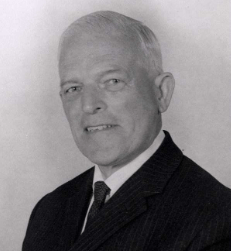
I’m a child of the 50’s. I didn’t quite make it in time for the Festival – but I was around for the coronation of Queen Elizabeth II in 1953! Well, not at the event – I was 3 weeks old at the time! I’m a proud Londoner and lived there until 1979. Many of my memories of London through the 50’s and early 60’s seem to be in black and white (is that just me?) I had a wonderful childhood, but the city was dreary and dirty. Just looking at the 1951 window reminds me that the 1950s were in fact full of light and a wonderful time to be a child!
The Canadian Broadcasting Corporation highlighted the story in 2018 in an article, “A stained glass window shows the ‘bond of friendship’ between Windsor, Ontario and Windsor, UK“, which is still available online.
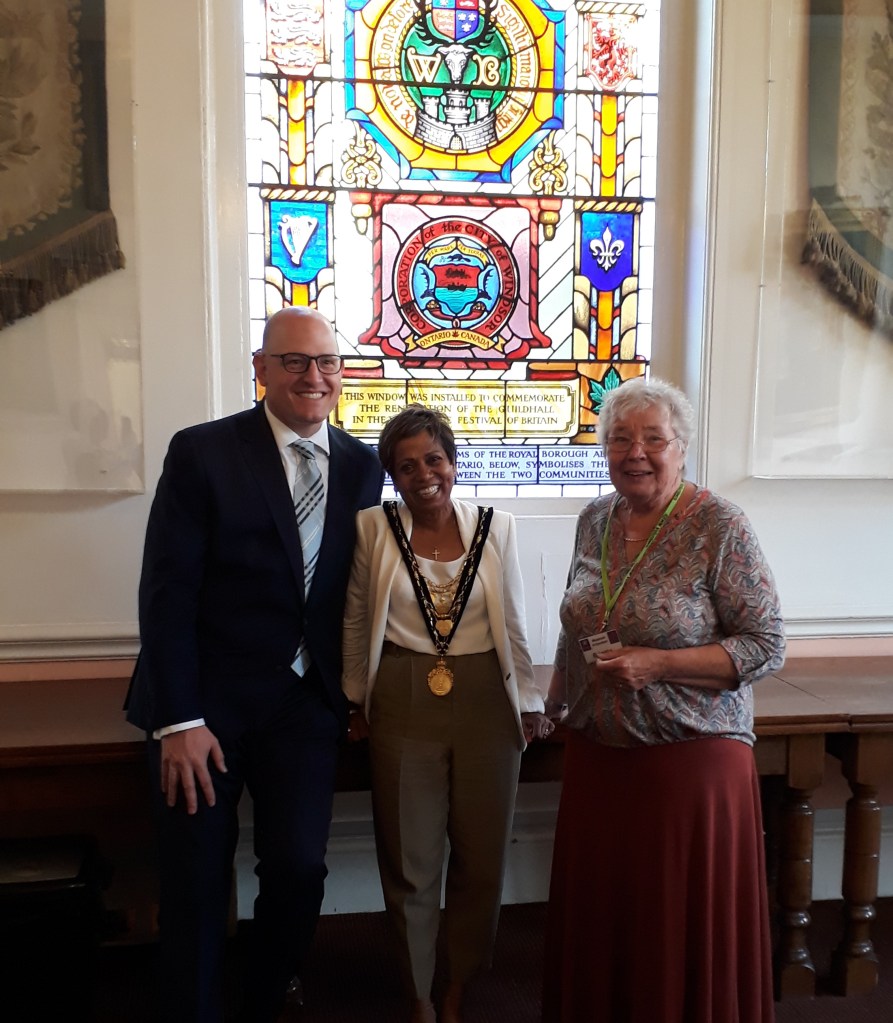
Brigitte (then Chair of the Friends) met Mayor Dilkens on a visit to Windsor on her 2016 trip to Canada. She’d presented him with a photo of the 1951 window and a newspaper cutting. Both he and the local museum were unaware of the existence of the window. The mayor of Windsor could not come to the unveiling in 1951, but subsequently came to the UK and attended the coronation of Queen Elizabeth II. Mayor Dilkens knew nothing about this and took the opportunity of a visit to England in 2019 to see Windsor (and the window) for himself. See more of the story here:
The trip was also covered in our own Winter 2016 newsletter. We have digitised the paper copy, which was black and white only, and made it available here:
*Fun fact – how many Windsors are there in the world? The answer is between 20 and 46! It just depends on which website you believe. Google it and find out where they are!
by Gerald Hyder
The 1861 Receipt
One of my favourite objects comes from the old Clewer Museum that is now part of the Collection. I haven’t physically seen it, only this photo from the St Andrew’s Millennium Boards, as it is currently in the Museum’s Archive store.
Over 163 years ago, on 30th November 1861, James Stevens was the landlord of The Swan. He had provided a day of food and beer for which The Swan has always been famous. It was held on St Andrew’s Day, the linkage with the local church is quite clear.
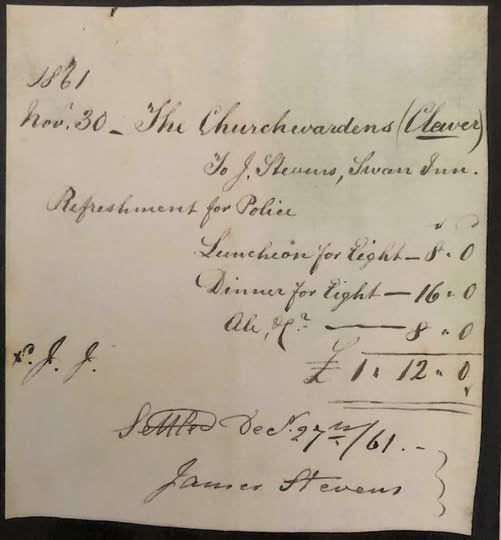
It appears that the Churchwardens of Clewer (Parish, aka St Andrew’s Church) were paying the bill for “Refreshments for the Police” which included 8/- for lunch, 16/- for dinner and ale at 8/-. They were obviously well-fed and took advantage of someone else paying. It was settled on 27 Dec 1861. It is initialed JJ, which could be J Jones, who was one of the churchwardens at the time.
In 1861, the new Berkshire County Constabulary rented the house behind The Clewer Village Smithy, both of which James Stevens owned (now Villiers Court). They were separate from the New Windsor Police. PC Herbert Reece (28) was staying there along with Caroline (33), his wife and their daughter. A second PC, John Cutbush (22), was boarding there too.
Who the eight were we will never know, but we can assume the two PCs staying locally – Herbert Reece and John Cutbush – were probably there. We can only speculate that Inspector Reece, a Sergeant or two, and the rest of the local PCs including Mason.
A real snapshot in the history of The Swan and of Clewer Village.
 Friends of Windsor Museum