
The Guards March and Changing the Guard is a Windsor institution and surely one not to be missed if you are visiting. It has all the pomp and ceremony we have come to expect of our wonderful Army serving our Sovereign. And you can witness it first-hand!

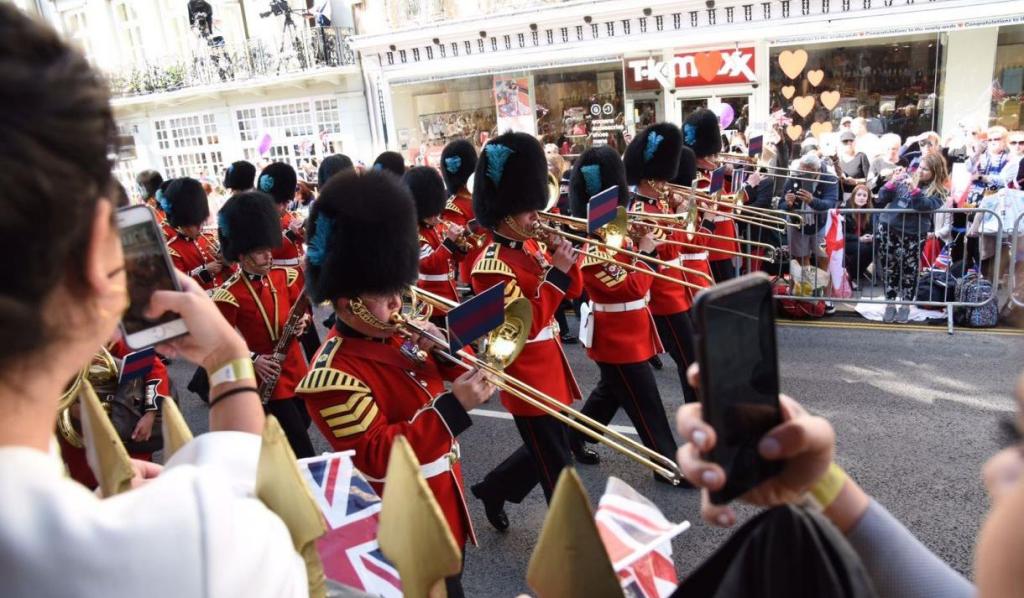
Pictures from VisitWindsor and used with their permission. Photographers Doug Harding & Nicola Bell.
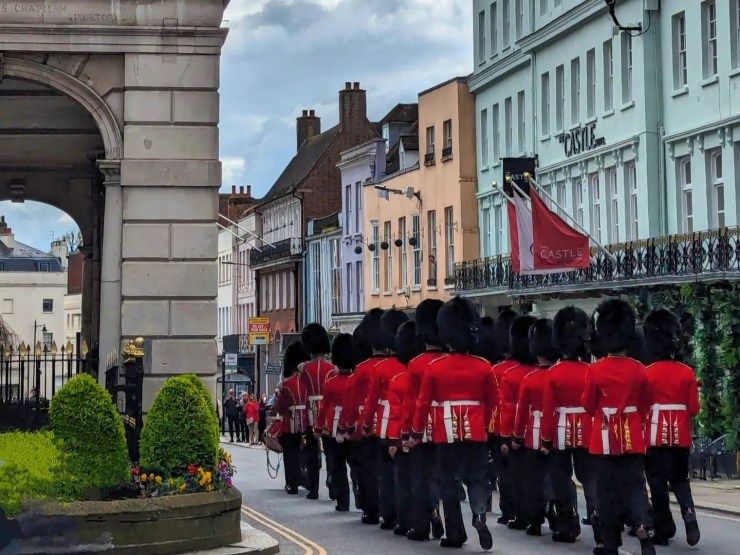
The New Guard forms up and marches from the local barracks to Windsor Castle, led by a Regimental Band. The Changing of the Guard ceremony happens at 11 am within the castle (tickets required), and the Old Guard marches back shortly afterwards. All seven of the British Army Regiments serving our Sovereign’s Household Division participate and, on occasion, the honour is extended to other regiments. The parades take place year-round on Tuesdays, Thursdays and Saturdays, subject to the weather.
The Guards have carried out the duty of protecting the Sovereign since 1660.
And what is the Captain’s Inspection?
The Captain’s Inspection at Windsor Castle is a military ceremony where the Captain of the Guard formally inspects the soldiers on duty, ensuring they meet the required standards. It takes place at 3 pm on Mondays, Wednesdays, and Fridays, coinciding with the days that the full Changing of the Guard ceremony does not occur. This inspection, traditionally conducted in private, is now open to the public, offering visitors a glimpse into this historic military tradition. Please note that there is no musical support for the Captain’s Inspection.
When are they?
The schedule is set by the Army and is subject to change for operational and weather-related reasons. It is advisable to check in advance with the relevant websites for any changes. The Visit Windsor and The Household Division websites have all the published dates.
February
| Date | Unit | Type | Time | Musical Support |
| Mon 2nd February | 1st Battalion Grenadier Guard | Captain’s Inspection | 15:00 | NO MUSIC |
| Tue 3rd February | 1st Battalion Grenadier Guards | Guard Change | 11:00 | Corps of Drums of the 1st Battalion Grenadier Guards |
| Wed 4th February | 1st Battalion Grenadier Guards | Captain’s Inspection | 15:00 | NO MUSIC |
| Thu 5th February | 1st Battalion Grenadier Guards | Guard Change | 11:00 | Band of the Household Cavalry |
| Fri 6th February | 1st Battalion Grenadier Guards | Captain’s Inspection | 15:00 | NO MUSIC |
| Sat 7th February | 1st Battalion Grenadier Guards | Guard Change | 11:00 | Corps of Drums of the 1st Battalion Grenadier Guards |
| Mon 9th February | 1st Battalion Grenadier Guards | Captain’s Inspection | 15:00 | NO MUSIC |
| Tue 10th February | 1st Battalion Grenadier Guards | Guard Change | 11:00 | Corps of Drums of the 1st Battalion Grenadier Guards |
| Wed 11th February | 1st Battalion Grenadier Guards | Captain’s Inspection | 15:00 | NO MUSIC |
| Thu 12th February | 1st Battalion Grenadier Guards | Guard Change | 11:00 | Corps of Drums of the 1st Battalion Grenadier Guards |
| Fri 13th February | 1st Battalion Grenadier Guards | Captain’s Inspection | 15:00 | NO MUSIC |
| Sat 14th February | 1st Battalion Grenadier Guards | Guard Change | 11:00 | Corps of Drums of the 1st Battalion Grenadier Guards |
| Mon 16th February | 1st Battalion Grenadier Guards | Captain’s Inspection | 15:00 | NO MUSIC |
| Tue 17th February | 1st Battalion Grenadier Guards | Guard Change | 11:00 | Corps of Drums of the 1st Battalion Grenadier Guards |
| Wed 18th February | 1st Battalion Grenadier Guards | Captain’s Inspection | 15:00 | NO MUSIC |
| Thu 19th February | 1st Battalion Grenadier Guards | Guard Change | 11:00 | Corps of Drums of the 1st Battalion Grenadier Guards |
| Fri 20th February | 1st Battalion Grenadier Guards | Captain’s Inspection | 15:00 | NO MUSIC |
| Sat 21st February | 1st Battalion Grenadier Guards | Guard Change | 11:00 | Corps of Drums of the 1st Battalion Grenadier Guards |
| Mon 23rd February | 1st Battalion Grenadier Guards | Captain’s Inspection | 15:00 | NO MUSIC |
| Tue 24th February | 1st Battalion Grenadier Guards | Guard Change | 11:00 | Band of the Coldstream Guards |
| Wed 25th February | 1st Battalion Grenadier Guards | Captain’s Inspection | 15:00 | NO MUSIC |
| Thu 26th February | 1st Battalion Grenadier Guards | Guard Change | 11:00 | Band of the Irish Guards |
| Fri 27th February | 1st Battalion Grenadier Guards | Captain’s Inspection | 15:00 | NO MUSIC |
| Sat 28th February | 1st Battalion Grenadier Guards | Guard Change | 11:00 | Band of the Household Cavalry |
See more about the Guards and Bands involved below.
What is the route?
The parade leaves Victoria Barracks at 10.45 am and proceeds up Sheet Street into the High Street. It then passes Windsor Parish Church of St John the Baptist (with the War Memorial directly in front), then the Guildhall to the Queen Victoria statue, and up Castle Hill into the Castle itself. The parade then reverses the route at 11.25 am, returning to Victoria Barracks.
The map is presented using Google Maps
Please note that the roads in the area are sealed off by crash-proof barriers blocking all of the access roads and that armed Police are present. If you have any questions, there are also helpful Windsor Ambassadors in attendance.
Where to watch it?
We would suggest that the best place to watch the Guards March is from the Corn Market at the front of the Guildhall, just in front of the entrance to the Museum. It is slightly elevated and has railings for your protection. Apart from inside the castle itself, in our opinion, this provides the very best view of the parade.
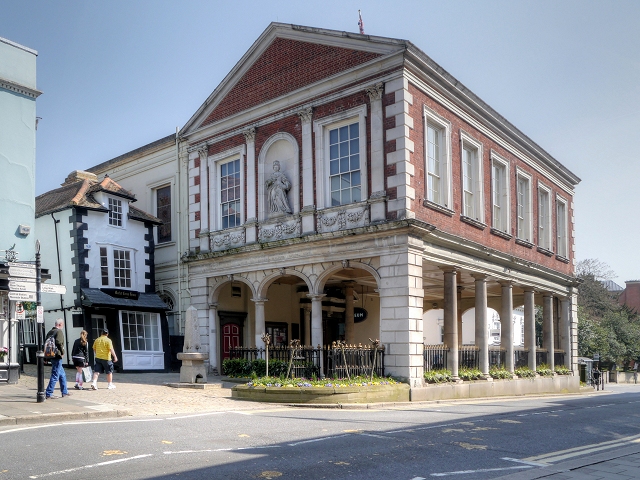
And after the parade on a Tuesday or Wednesday, you can pop straight into the Museum and learn more about Windsor, Royalty and notable events such as the world’s first airmail service, and see where the King and Queen were married and also where Elton John and David Furnish had their Civil Partnership ceremony.
The Guards
The Household Division forms part of the British Army’s London District and is made up of five regiments of foot guards and two regiments of the Household Cavalry. The division is responsible for delivering all state ceremonial and public duties.
Each of the foot guards’ uniforms is slightly different. It can be difficult to tell them apart. However, the article “Know your uniforms: the seven regiments of the Household Division explained” will help you immensely.
Coldstream Guards
The oldest continuously serving regiment in the British Army, with origins back to the English Civil War. They specialise in light role operations: reconnaissance, operating machine guns and mortars, and engaging enemy troops on foot and in light vehicles. Learn more about the Coldstream Guards.

Grenadier Guards
Formed in 1656, The Grenadier Guards is one of the oldest and most recognised regiments in the British Army. They execute their role as light infantry experts abroad in war and in peace. They are based at the Lille Barracks in Aldershot, Hampshire. Learn more about the Grenadier Guards.
Scots Guards
Formed over 375 years ago, the Scots Guards has forged a reputation as one of the toughest fighting units in the British Army. They operate as a Light Mechanised regiment and are based at the Catterick Garrison and Wellington Barracks, London. Learn more about the Scots Guards.
Irish Guards
The regiment was first raised in 1662 for service in Ireland and continues to recruit from Northern Ireland or Irish descents. Experts in light infantry actions, the Irish Guards are world-famous, as is their Irish Wolfhound mascot. They are based in Hounslow, west London. Learn more about the Irish Guards.

Welsh Guards
This senior Welsh infantry regiment was founded in 1915. They operate as Light Role Infantry, allowing them to lead from the front as a mobile and flexible attack force. They are based in the Combermere Barracks, Windsor. Learn more about the Welsh Guards.
Household Cavalry
The Household Cavalry unites the British Army’s two most senior regiments: The Life Guards and The Blues & Royals. It now comprises the Household Cavalry Regiment and the Household Cavalry Mounted Regiment and provides armoured reconnaissance capability. Learn more about the Household Cavalry.
Visiting Regiments
10 Queen’s Own Gurkha Logistic Regiment
10 Queen’s Own Gurkha Logistic Regiment is divided into several Squadrons and is stationed across the UK. The Regiment’s primary function is as a Theatre Logistic Regiment. Gurkha soldiers are recruited in Nepal. Officers are recruited from the UK and the Commonwealth. Learn more about the Gurkha Logistic Regiment.
The Bands
Music played by the bands includes music representing their regiment, their origin, and a real mixture of traditional and popular tunes. The highly experienced musicians are led by a conductor of music and play throughout the Guard March. The Guard March at Windsor is a small part of the ceremonial and soldiering activities that the bands perform.
Band of the Welsh Guards
The Band of the Welsh Guards was formed in 1915 in the same year as the Regiment. It is comprised of musicians from The Royal Corps of Army Music and is one of 14 Regular Army Bands in the British Army. It is based in central London. Learn more about the Band of the Welsh Guards.
Band of the Brigade of Gurkhas
Raised in November 1859 with 16 Bandsmen, the Band has grown over the years. After basic training, Bandsmen undergo musical instruction from the Director of Music followed by four years at the Royal Military School of Music. As well as public performances in the UK, they perform worldwide. Learn more about the Band of the Gurkhas.
Band of the Irish Guards
The Band of the Irish Guards is comprised of musicians from The Royal Corps of Army Music, it was formed on 1st April 1900, to commemorate the bravery of the men from Irish Regiments who fought with distinction in the South African campaigns. Throughout its proud history, the Band’s prime duty has been to play for the ‘Changing the Guard’ at Buckingham Palace and Windsor Castle.
Band of the Household Cavalry
The Band of the Household Cavalry was formed in September 2014 by the union of The Band of The Life Guards with The Band of The Blues and Royals, the two mounted bands of the British Army. With over sixty musicians, the band is now the largest regular military band in the UK.
The Band of the Coldstream Guards
The Band of the Coldstream Guards is one of the oldest and best-known military bands in the world. Formed in 1650, it is the oldest regiment in the British Army by continuous succession. The band has performed in some of the world’s best and most prestigious concert halls.
 Friends of Windsor Museum